

Trademark registration process India — step by step guide for startups and businesses
Your Brand Is an Asset — But Only If You Protect It Correctly
A trademark is more than a logo or a business name. It is the legal foundation of your brand — the right that allows you to prevent others from using a name, mark, or symbol that is identical or deceptively similar to yours in the marketplace. For businesses of any size, early trademark registration is one of the most commercially important legal steps available, yet it is frequently delayed or overlooked until an infringement problem has already arisen. At that point, the cost of enforcement — and the risk of losing rights to a competing mark — is far greater than the cost of timely registration would have been.



In India, trademark registration is governed by the Trade Marks Act, 1999, and applications are filed before the Trade Marks Registry. A registered trademark gives the owner the exclusive right to use the mark in relation to the registered goods and services and provides a strong legal basis for enforcement against infringers. Registration also gives the mark owner the right to use the ® symbol, which itself acts as a deterrent to potential infringers. From the date of filing, the applicant can enforce rights against infringers in many situations, making early filing strategically important.
The Trademark Registration Process in India
- Trademark Search
- Conduct a comprehensive search of the Trade Marks Registry database to check for existing marks that are identical or deceptively similar to the proposed mark. A clear search result does not guarantee registration, but a conflicting mark discovered at the search stage avoids a costly misfiling.
- Class Identification
- Identify the correct class or classes under the Nice Classification (45 classes in total) that cover the goods and/or services your business provides. Filing in the wrong class provides no protection for your actual business activities.
- Filing the Application
- File the trademark application before the Trade Marks Registry in the prescribed form with the prescribed fee. Multi-class applications are available under a single filing for businesses operating across multiple categories.
- Examination Report
- The Registry examines the application and may raise objections on absolute or relative grounds. A written response to the examination report must be filed within 30 days. If the objection is maintained, a hearing is scheduled before the Registrar.
- Attending the Hearing
- If the examination report objection is not resolved through the written response, the applicant must attend a hearing before the Trade Marks Registry and make submissions in support of registration.
- Publication in the Trade Marks Journal
- Once accepted, the mark is published in the Trade Marks Journal for a four-month opposition window during which third parties may oppose registration.
- Registration Certificate
- If no opposition is filed — or if any opposition is decided in the applicant’s favour — the certificate of registration is issued. The trademark is valid for ten years from the date of filing and is renewable indefinitely.
The entire process from filing to registration typically takes between 18 and 36 months when the application is not opposed. During this period, the applicant has the right to use the ™ symbol and can assert rights against infringers in many circumstances.
Filing a trademark application on the day you launch your brand — not months or years later — is the single most effective way to protect your business identity from the outset. The date of filing is the date your legal protection begins.
Common Mistakes to Avoid in Trademark Filing
- Choosing a mark that is purely descriptive of the goods or services — these are difficult to register and enforce
- Filing in the wrong class or omitting a class that covers an important part of your business
- Not conducting a prior art search before filing, leading to conflicts with existing registered marks
- Failing to respond to examination reports within the prescribed time, resulting in abandonment of the application
- Assuming that company name registration with the MCA provides trademark rights — it does not
- Not monitoring the Trade Marks Journal for conflicting applications filed by third parties after your own filing
Read This : Can I Use a Trademark Without Registering It in India? Understanding Common Law Rightsrkey
What Happens If Someone Opposes Your Trademark Application?
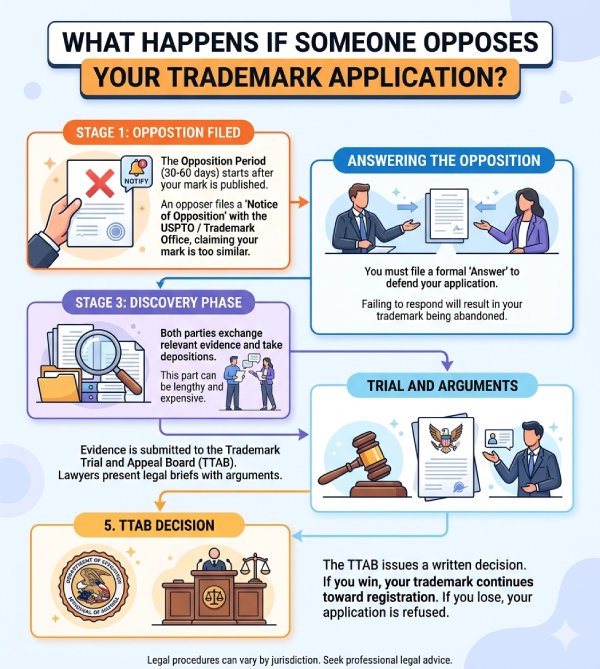
When a trademark is published in the Trade Marks Journal, any person may file a notice of opposition within four months of the date of advertisement. The opposition is filed before the Trade Marks Registry and sets out the grounds on which the opponent objects to registration — most commonly, that the applicant’s mark is deceptively similar to the opponent’s prior registered or pending mark in relation to the same or related goods or services.
Once an opposition is filed, the applicant must file a counter-statement within two months. The parties then exchange evidence by way of affidavit, and the matter is heard and decided by the Registrar. An opposition does not prevent the applicant from using their mark during the pendency of the proceedings — but it does delay registration and creates uncertainty. Decisions of the Registrar can be appealed to the Intellectual Property Appellate Board and thereafter to the High Court.
The most effective way to reduce the risk of a successful opposition is a thorough clearance search at the outset and careful selection of a mark that is distinctive, non-descriptive, and not confusingly similar to any existing registration in the relevant class. A mark that passes the clearance stage cleanly is also a mark that is stronger and easier to enforce if infringement occurs after registration.